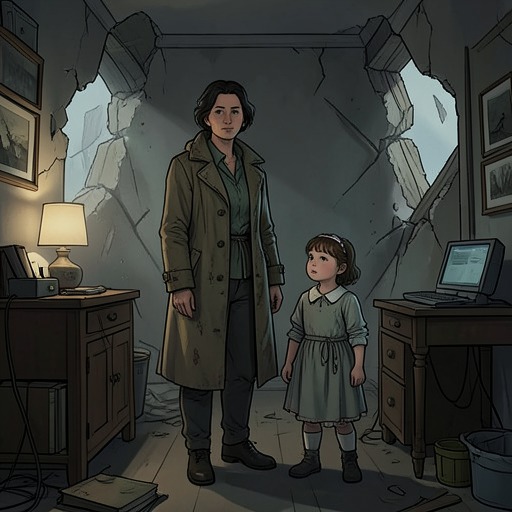
The double birth on the stormy night
Bird BoxThe double birth on the stormy night brings Malorie and Olympia into labor at the same time, turning the attic into an improvised delivery room and a place of urgent protection. With no doctor or medicine available, their children arrive amid the household’s wider crisis; Malorie gives birth to a boy, Olympia to a girl, and both newborns’ eyes are covered. The episode binds birth to care, fear, and the uncertain survival of the community.
Circumstances and preparation
The births take place against a background of practical work and gathering danger. Earlier, Cheryl had waited inside the kitchen behind the closed back door while Felix went to the well, serving as a safety net in case something went wrong outside. The arrangement reflects the housemates’ everyday division of risk: ordinary necessities such as water still require precautions and someone standing by.
Malorie’s approaching labor is a constant concern. She wishes there were a doctor in the house and tries to imagine birth as a brief experience, picturing the moment her water breaks and the baby in her arms while avoiding the uncertain interval between them. Her hope for medical help is set against the reality of no doctors, medicine, friends, or family to assist her.
The household has also been strained by panic and disagreement. Malorie eventually redirects the others toward concrete chores: preparing dinner, emptying the waste bucket, arranging the cellar, looking for tools, feeding the birds, making telephone calls, and washing bedding. Her assignment of tasks makes the household function again, if only for a moment. The scene establishes the practical labor surrounding the births: survival depends not only on protection from outside danger but on the repeated work of maintaining a home.
The move to the attic
When Malorie’s labor begins, Tom’s plan determines where the birth will take place. Felix explains that the attic is considered the safest part of the house in case something happens. Olympia is already there, and Tom and Cheryl are with her. Felix and Jules help Malorie from her room and up the old wooden stairs, while blankets remain over the window at the end of the hall. Malorie, disoriented by the onset of labor, cannot tell how much time has passed.
The attic is more spacious than Malorie expected. A single candle provides light; Olympia lies on a towel with a sheet covering her, Cheryl beside her, while Jules settles Malorie on a separate towel facing Olympia. The two women’s positions make the births a shared scene rather than separate ordeals. Tom moves between them, speaking gently to Olympia, and Malorie begins to think her own experience may not be as far from what she had hoped as she feared.
The arrangement offers assistance, but not the care Malorie had wished for. There is no doctor to take charge. The housemates’ roles are improvised: Tom and Cheryl are already attending Olympia, Felix and Jules bring Malorie upstairs, and the available space and supplies must serve as a delivery room. The attic’s relative safety therefore does not remove the danger; it concentrates the household’s effort on getting both women through labor while keeping the threat outside.
Two births and the protection of the newborns
As labor intensifies, Malorie’s attention narrows to the fact that her baby is coming. She wonders whether motherhood will change how she sees the world, which she has already understood through the prism of pregnancy. At the same time, her thoughts turn toward Tom and whether his ideas will sound different to her after the birth. The scene holds those questions beside the immediate physical demands of labor rather than resolving them in advance.
Olympia’s child cries first. Malorie’s own baby is crowning, and she pushes; when he is born, she cups his eyes, believing she has reached him in time. She cuts the cord with a steak knife, uses strips cut from the bloodied towel to cover his eyes, and identifies the baby as a boy. With no sister, parent, nurse, or Tom beside her to tell, she holds him close and ties the cloth around his eyes herself. Birth and protection become one continuous act: the child enters the world, and Malorie immediately tries to shield him from it.
Malorie then asks to see Olympia’s baby. Olympia calls her over and urges her to look; Malorie finds a girl. She ties the second strip of towel around the newborn’s eyes. Her care for the other child extends beyond the practical act of covering her eyes: Malorie will remember that Olympia did right by her daughter even after losing her composure. In the same moment, Olympia’s handoff makes the bond between the women consequential, not merely sympathetic. Malorie receives and protects the child as well as her own.
Consequences and significance
The births do not end the danger in the house. After the second child is born, Olympia moves toward the draped window, where Gary stands, while the threat remains present behind Malorie. Later, Malorie hangs up the telephone and cries for twenty minutes before Victor barks from the cellar. She rehanges the blankets, closes the doors, and plans to search every part of the home with a broomstick before opening her eyes. It will be six hours before she feels safe enough to see what happened while she was delivering her baby.
The immediate aftermath makes clear that childbirth has occurred within, not outside, the household’s emergency. Malorie must care for two newborns while continuing to observe the rules that protect the survivors from unseen creatures. On her way back through the house, with her eyes still closed, she steps beside Tom’s body. The contrast is stark: two children have entered the world, but the person whose plan placed Malorie in the attic is dead.
The episode’s significance lies in the way it gives survival the scale of intimate, practical care. Tom’s choice of the attic, the housemates’ assistance, Malorie’s improvised use of a knife and towel, and Olympia’s entrusting of her daughter all shape the outcome. The births offer no uncomplicated resolution. They establish two new lives and a connection between the mothers, while leaving Malorie with immediate responsibility, continuing danger, and the loss of Tom.